
Court Events After Release
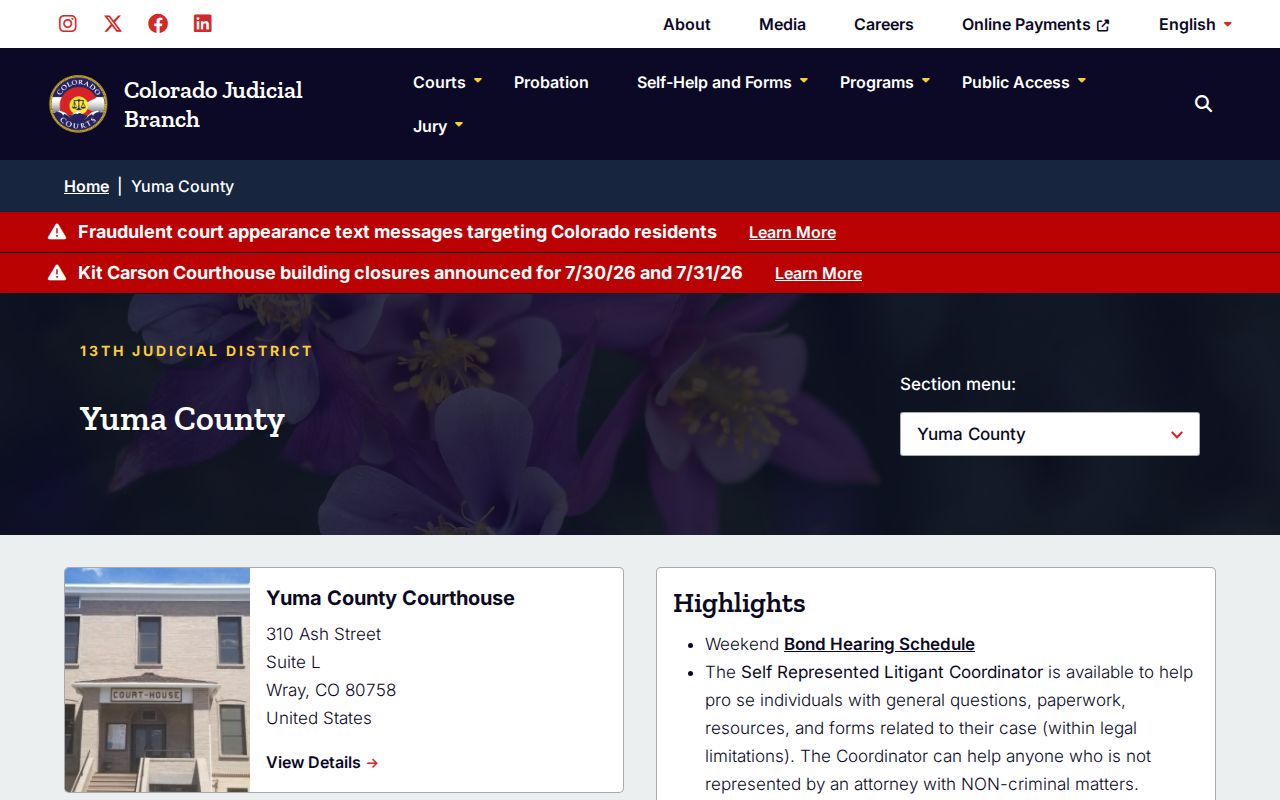
The Colorado Judicial Branch Yuma County page links docket search, records request, payments, interpreter, transcript, ADA, probation contact, local filing instructions, and a weekend bond hearing schedule. Those court tools matter because a person may be absent from jail for several different legal reasons. The court record can distinguish a bond release from a dismissal, a sentence served from probation, and a county jail release from commitment to CDOC.
Confirm Through the Case
- Start with the Colorado Judicial Branch Yuma County docket link. The statewide docket search requires at least one filter in addition to date.
- Use party name, case number, county, court location, or other available case details to narrow the search.
- Look for bond status, release order, warrant canceled, sentencing, probation, mittimus, revocation, or next-hearing entries.
- For deeper history, use the clerk records path or CoCourts Register of Action, which is separate from a free docket calendar.
Courthouse Records and Contact
Yuma County Courthouse
310 Ash Street, Suite L
Wray, CO 80758
Phone: 970-592-6120
Fax: 970-332-4119
Email: yumacountycourts@judicial.state.co.us
The county Additional Departments page lists County Court and District Courts hours as Monday through Thursday 8 a.m. to noon and 1 p.m. to 4 p.m., and Friday 8 a.m. to 1 p.m. Court records questions should go to the clerk or official Judicial Branch process, not to the sheriff, unless the record sought is a jail booking or release record.
Ash Street Record Roles
The courthouse, sheriff, probation, and county offices are clustered around 310 Ash Street in Wray, but they do not answer the same release question. The jail can confirm custody and release from the facility. The court can explain the case event that caused release or transfer. Probation can address court supervision. A county records request may be needed for an official sheriff release record.
Local operations context also matters. County minutes from 2022 mention inmate contracting discussions tied to staffing challenges. Do not treat that as a current custody contract, but it is a reminder that "transfer" can be a record outcome that needs a destination and authority.
Why Court Records Matter
Yuma County court records are central because the Colorado Yuma County jail does not appear to publish a public current roster, 24-hour release list, or 72-hour release list. Once a person leaves the jail, there may be no public jail page to refresh. The court case is often the durable public path because it can show the order, hearing, sentence, or disposition that explains why the person left custody.
A court entry may show bond posted, personal recognizance release, dismissal, deferred judgment, probation sentence, jail sentence, time served, mittimus to CDOC, warrant canceled, or revocation. Those are not interchangeable. Bond means the case may continue. A mittimus or commitment points away from county-jail release and toward CDOC intake or another custody path. A probation sentence points to court supervision. A dismissal or completed sentence should be confirmed in the case record rather than assumed from absence on a jail page.
The Yuma County Judicial Branch page also links a weekend bond hearing schedule. That is a useful local detail for recent custody questions because someone booked near a weekend may depend on a bond-hearing process rather than an ordinary weekday clerk counter. The exact schedule should be checked through the court source, but the presence of that link explains why jail release timing can turn on court availability.
Docket and Register of Action
The statewide Colorado Judicial Branch docket search requires at least one filter in addition to date. A searcher should prepare a party name, case number, county, court location, or other identifying detail before trying to confirm a release-related event. A date-only search may fail or return too little context. In a small county, spelling and initials still matter, and the court record may use the name on the case rather than a later name variation.
The free docket is useful for schedules and visible court activity, but it is not the same thing as a complete case history. CoCourts states that its court record searches provide a Register of Action. A Register of Action can be more useful when the question is "what happened in the case after booking?" because it may show a sequence of filings, orders, and disposition entries. Use the clerk records path or CoCourts route when a public docket calendar does not answer the release question.
When reading docket language, look for the event that controls custody. "Bond posted" or a release order supports a jail release while the case continues. "Probation" supports court supervision rather than CDOC parole. "Mittimus" or prison sentence language suggests transfer to Colorado Department of Corrections custody, where CDOC offender search becomes the better release-date system. "Revocation" can mean the person returned to custody after a supervision event.
Release, Sentence, Transfer
The courthouse page should not collapse every custody change into "released." A person can be gone from Yuma County Jail because bond was posted, a judge ordered release, a jail sentence was completed, a warrant was cleared, or the case was dismissed. A person can also be gone because the court committed the person to CDOC, another county had a hold, federal authorities took custody, or an immigration detainer led to transfer. The court record is the place to look for that legal distinction.
Sentence completion also has layers. Completion of jail time can end the jail portion while fines, restitution, protection orders, probation, or future hearings remain. Completion of probation can end court supervision. CDOC discharge can end prison or parole sentence jurisdiction. A court page should therefore answer the narrower question first: what event did the case record show, and which agency has the person or record now?
If the record points to CDOC, use the Colorado Department of Corrections offender search at https://www.doc.state.co.us/oss/. CDOC search is for state prison, parole, discharge, and many post-release statuses. It is not the right tool for every person booked into Yuma County Jail. A defendant who bonds out from the county jail may never appear in CDOC, while a defendant sentenced to state prison may later show CDOC release or discharge information that the county jail will not maintain as a state-prison record.
Records Requests and Fees
For court records, use the Colorado Judicial Branch court-record process or the Yuma County Courthouse contact. For county administrative records or sheriff records, Yuma County's CORA procedure may apply, and criminal justice records may be evaluated under CCJRA. The county administrator contact for the public-records request form is 310 Ash Street, Suite A, Wray, CO 80758, phone 970-332-5796 ext. 221. The courthouse itself is Suite L at the same Ash Street complex, so routing matters.
Yuma County's public-records procedure says requests must be written to the official custodian and specific as to the records and dates sought. Requests mailed or sent by facsimile may be accepted under the county process. Email is not automatically accepted unless the custodian chooses to accept it, and a request sent to the wrong email does not start the response clock until the custodian confirms receipt. A vague request can be returned for narrowing, and the response time does not begin until the request is sufficiently specific and any required deposit is paid.
The county publishes concrete fees and timing. Standard-page copies cost 25 cents. Research and retrieval can be charged at actual cost, capped at $41.37 per hour. The custodian may provide an estimate and require a deposit before retrieval. Normal production is three working days beginning on the first business day after deposit payment, with an extenuating-circumstances extension that generally should not exceed seven working days after notice within the three-day period.
Sealed or Missing Results
A missing court result does not always mean the person was never booked or never released. Missing results can come from spelling differences, date-range problems, use of the prosecuted name rather than another name, a different jurisdiction, an old record path, transfer to another agency, or lawful access limits. Colorado sealing rules are especially important. Public-records guidance notes that after sealing, the defendant and criminal justice agencies may properly reply that public criminal records do not exist with respect to the person.
Sealing and expungement can affect whether a release, booking photograph, or docket event remains publicly visible. Court records may also be limited after no charges, dismissal, acquittal, completed diversion, or completed deferred judgment when statutory requirements are met. Juvenile records have additional confidentiality limits. The courthouse page should keep this explanation neutral: contact the court or proper custodian for the official answer, and use Colorado Judicial Branch forms, legal help, or an attorney for questions about eligibility or petitions.
Booking photos are not courthouse release records by default. If a photo is sought from a criminal justice agency, Colorado law at C.R.S. 24-72-305.5 requires a requester statement and restricts obtaining booking photographs for a publication or website that requires payment or other pecuniary gain for removal. The court record may explain disposition, but the sheriff, CDOC, CBI, or another custodian may hold the photo depending on the source.
Colorado, Not Arizona
The courthouse page should be explicit about the wrong-Yuma problem. Search engines surface Yuma County, Arizona sheriff pages, detention release pages, Arizona records-request instructions, and Arizona inmate portals for similar searches. Those sources are not the 13th Judicial District courthouse in Wray, Colorado. Colorado Yuma County court contacts use 310 Ash Street, Suite L, Wray, CO 80758, phone 970-592-6120, fax 970-332-4119, and email yumacountycourts@judicial.state.co.us.
Use the Colorado domains and contacts as trust signals. Sheriff custody questions belong with the Yuma County Sheriff's Office at Suite G or the jail phone. Court disposition, bond, sentence, and docket questions belong with the courthouse and Judicial Branch sources. Probation questions belong with the Yuma County Probation Office at Suite H or the probation department number. That office-by-office separation is the most reliable way to avoid applying Arizona procedures to a Colorado case.