
When a Yuma Case Reaches the Board
Colorado parole hearings are part of the state-prison release path. They apply to people in CDOC custody, people being considered for release to parole after a Colorado prison sentence, and some parole-related matters after release. They do not apply to every person who leaves Yuma County Jail. A person released locally on bond, time served, dismissal, a county sentence, or a probation order should be researched through the Yuma County Sheriff's Office, the Yuma County court docket, the local probation office if probation is involved, and written records requests when an official release record is needed.
The distinction matters because Yuma County has no state prison identified in the research and no public county jail release feed was found. A Yuma County case reaches the Colorado State Board of Parole only after a CDOC sentence or a parole-violation matter. The person may have started at the Yuma County Jail in Wray, but the hearing schedule is a state record once the sentence is in CDOC. The county court file remains important because it shows the sentence, mittimus, revocation, or order that put the person into the state-prison path.
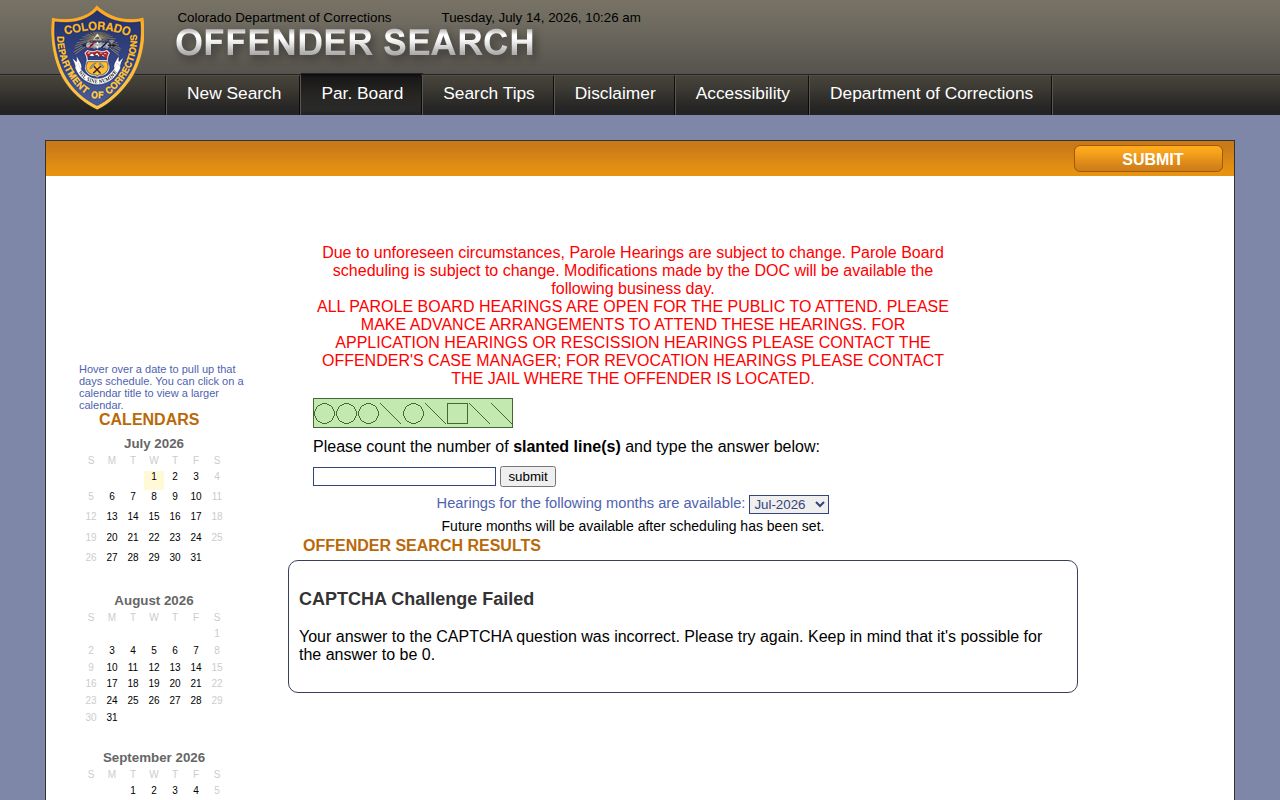
The public schedule path is the CDOC offender-search site's Par. Board tab at https://www.doc.state.co.us/oss/index.php?ref=pblist. The page displays monthly calendars for current and future months. It instructs users to hover over dates to pull up that day's schedule and to click a calendar title for a larger calendar. This makes the calendar useful for upcoming parole hearing research, but it is not a substitute for confirming actual release after the hearing date has passed.
Using the Par. Board Calendar
The calendar should be used as a schedule tool. Start at the CDOC offender search, confirm the likely person through DOCNO or name, then open the Par. Board tab for monthly hearing schedules. CDOC search tips say DOCNO is the primary identifier and that name records may use the arresting or prosecuted name rather than the current legal name. That name caveat applies here too: a hearing schedule can be hard to match if the person uses a different current name than the CDOC record.
- Confirm that the person has a CDOC path, not only a Yuma County Jail release.
- Use DOCNO when available. If not, search by last name and first name with spelling variations.
- Open the CDOC offender profile and compare status, sentence, and date information.
- Use the Par. Board tab to review monthly calendars and date-level schedules if the interface displays them.
- After the scheduled date, re-check CDOC status and relevant court or parole records before calling the person released.
The calendar interface is public, but this research did not find a separate current statewide parole decision search beyond the CDOC offender-search and parole-board interface. Older public-library material indicated that a parole-board site historically let users search scheduled hearings by individual, month, or county, but current page copy should direct users to the live CDOC Par. Board calendar and offender profile rather than promising a separate decision database that was not confirmed in the sweep.
Eligibility, Earned Time, and CDOC Computation
Eligibility is not release. C.R.S. 17-22.5-403 supplies Colorado parole eligibility timing. The research summary states that many felony offenders may become eligible after serving 50 percent of the sentence imposed, less earned time. For specified violent crimes committed on or after July 1, 2004 and before January 1, 2025, the summary states eligibility after 75 percent, less earned time. Proposition 128 changed rules for covered crimes of violence committed on or after January 1, 2025, with an 85 percent requirement before discretionary parole or earned-time reductions for those covered offenses and additional limits for a third or later covered violent crime.
Earned time comes from C.R.S. 17-22.5-405. The research summary states that earned time, not exceeding ten days for each month of incarceration or parole, may be deducted for certified consistent progress in areas such as work, training, group living, counseling, and program participation. It also notes a possible limit of not more than twelve days per month for certain class 4, 5, or 6 felony and level 3 or 4 drug felony sentences when statutory conditions are met.
The parole-board rule source is important because it separates the time calculation from the hearing decision. It says computation of time served on any sentence is CDOC's responsibility and is accepted by the Board. Therefore the Board does not become the general release-date calculator for a Yuma County sentence. CDOC computes the sentence and eligibility data. The Board uses those calculations in the hearing process and makes parole decisions within its authority.
Hearing Outcomes and Release Proof
Parole hearing outcomes should be described carefully unless the live CDOC detail page or board document supplies exact labels. General outcomes can include granted or released to parole, denied, deferred or continued, full-board review, rescission before release, revocation-related outcomes for people already on parole, or discharge and early-discharge issues where applicable. Those are workflow concepts, not guaranteed field names. The current record should be read from the live agency source.
A grant does not always mean the person left custody that day. A release can require processing, an approved plan, transport, paperwork, or additional checks. It can also be affected by a county hold, detainer, warrant, new sentence, federal or immigration custody, rescission, or other authority. For Yuma County research, compare the post-hearing CDOC status with the original Yuma County court case when the state sentence began in Wray. The court file can explain the conviction, sentence, mittimus, and later revocation events, while CDOC explains the state custody and parole status.
If the question is whether someone is still in prison, the current CDOC profile and custody status are more important than the schedule itself. If the question is what happened at the hearing, the user should look for any available board result details in the CDOC interface and use current Board or CDOC records channels if a public profile is not enough. If the question is why the person went to prison from Yuma County, the Yuma County courthouse record is the more direct source.
Probation Is a Local Court Path
Probation and parole are often mixed together, but they are different systems. Probation is a court sentence or condition managed through the judicial and probation system. Parole is release supervision after a state-prison sentence under CDOC and State Board of Parole authority. A person can be released from Yuma County Jail to probation without ever entering CDOC or appearing on a parole hearing calendar.
Yuma County has concrete local probation details. The county Additional Departments page lists the Yuma County Probation Office at 310 Ash Street, Suite H, Wray, Colorado 80758, Tuesday through Thursday from 8 a.m. to 5 p.m., phone 970-332-3273. The Colorado Judicial Branch Yuma County page also tells probationers to call their probation officer directly, email the officer at firstname.lastname@judicial.state.co.us, or call the probation department at 970-592-6159 and allow 24 hours for response.
For a person released from the county jail to probation, the best public route is usually the court case, not the parole calendar. The docket or Register of Action may show a probation sentence, deferred judgment, revocation complaint, review hearing, termination, or other court-supervision event. The probation office may not disclose every supervision detail to the public, but the office and court can route the person or authorized party to the correct process.
Yuma Jail Releases Are Separate
Yuma County, Colorado does not appear to publish a public current jail roster, 24-hour release list, 72-hour release list, or sheriff mobile jail app. That means the absence of a person from an online county source is not a parole clue. It may mean release, transfer, lack of a public feed, a name mismatch, a restricted record, or a custody event held by another agency.
For a same-day or recent local release, start with the Yuma County Sheriff's Office at 310 Ash Street, Suite G, Wray, office phone 970-332-4805, and the jail phone identified in the county jail source, 970-345-2244. Then check the Colorado Judicial Branch Yuma County docket for bond, release order, sentence, probation, warrant, or mittimus events. Colorado VINE can help with custody-status alerts if the person and facility are present in the feed, but VINE is a notification tool rather than a permanent court or jail archive.
For an official record, use a written request to the proper custodian. Yuma County's CORA page says requests must be specific as to records and dates, and that the custodian is not required to create a record that does not exist. A useful request for a release event identifies the person, date of birth if known, booking date or date range, case number if known, and the exact record sought, such as a booking or release record, release date and time, release authority, listed charges, bond information if held by the sheriff, or a releasable booking photograph if maintained.
Avoid the Wrong System
The most common mistake is treating every release question as a parole question. A Yuma County Jail release on bond is a county and court matter. A probation sentence is a local court and probation matter. A state-prison release or parole hearing is a CDOC and Board matter. A federal sentence belongs to BOP and federal court, while an immigration transfer belongs to ICE systems. Each route can involve the same person, but the records do not live in one database.
There is also a specific Yuma County search problem: results for Yuma County, Arizona often appear for the same search terms. Colorado pages should rely on Wray, Colorado facts, 970 phone numbers, the Yuma County Sheriff's Office site, Yuma County government pages, Colorado Judicial Branch pages, and CDOC sources. Arizona jail portals, Arizona release instructions, and Arizona records procedures do not confirm a release from Yuma County, Colorado.
Use the parole calendar when the person has a CDOC prison sentence or parole matter. Use the county sheriff and court when the person was locally booked and released. Use the profile and calendar together, and verify actual status after the scheduled date. That sequence keeps a hearing schedule, eligibility date, and actual release event in their proper places.