
When Yuma Cases Move to CDOC
The Colorado Department of Corrections offender search is the statewide route for a person who entered Colorado prison custody. It matters in Yuma County because a felony case filed in the 13th Judicial District can begin with an arrest and booking at Yuma County Jail, then leave the county system after sentencing or transfer. Once that happens, the later prison release, parole status, discharge status, and many date fields are CDOC records. They are not maintained as a Yuma County 24-hour or 72-hour jail release feed.
That distinction is the first accuracy check. The Yuma County Sheriff's Office at 310 Ash Street, Suite G, Wray, is the local starting point for short jail custody, bond release, time-served release, local sentence completion, court order, or transfer from the county jail. The sheriff site and county jail page confirm the jail service and phone paths, but this research did not find a Colorado Yuma County online current roster, recent-release feed, or public jail release archive. A person released locally on bond may never have a CDOC record.
CDOC becomes the correct system when the county case has resulted in a state-prison sentence, when a person is still in a Colorado prison, when the person has been released from prison to parole, or when a former prisoner has a discharge or sentence-status record in the state system. The public offender search is at https://www.doc.state.co.us/oss/. The search form shows fields for DOCNO, last name, first name, and gender, and the public menu includes New Search, Par. Board, Search Tips, Disclaimer, Accessibility, and Department of Corrections.
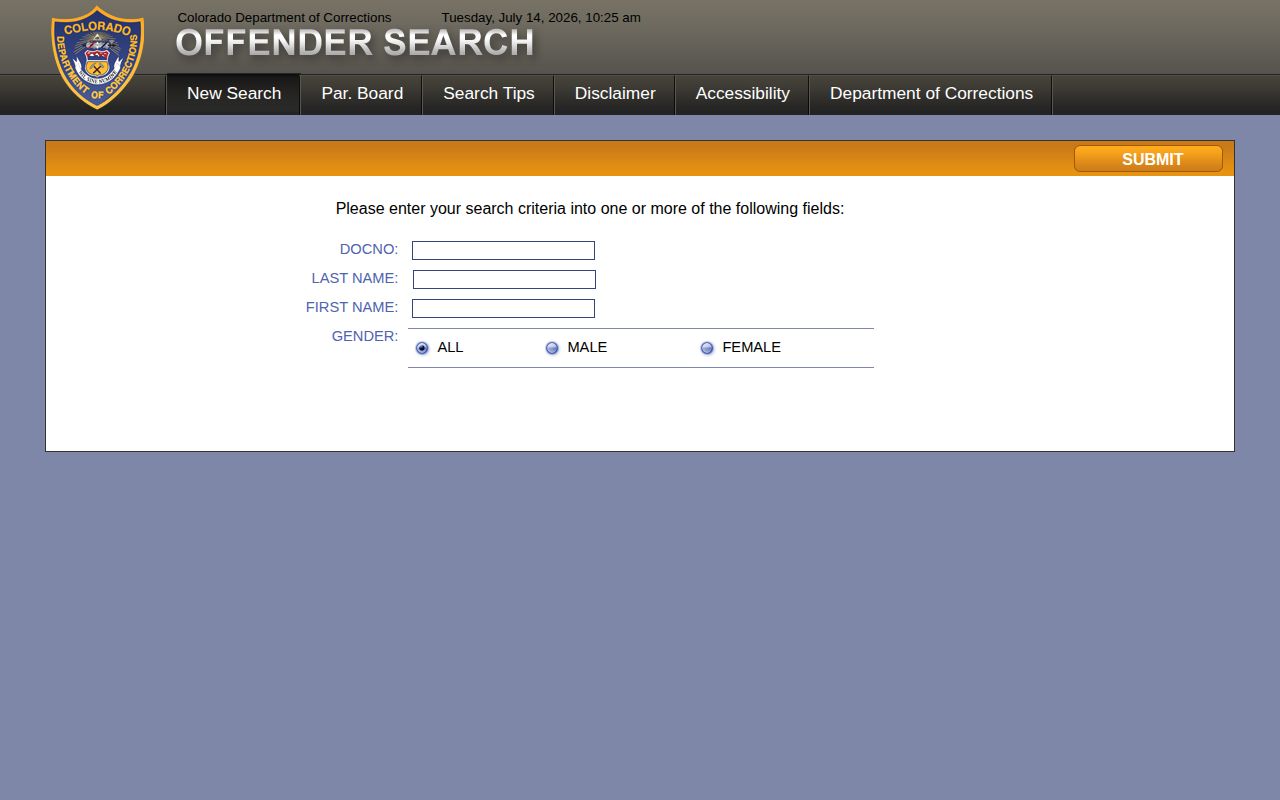
Search Fields and Name Caveats
Use DOCNO whenever it is available. CDOC's search tips identify the DOC number as the department's primary offender identifier. The tips describe it as a numeric identifier up to six characters long, which makes it more precise than a name query when two people have similar names or when a person has used more than one name over time.
Name searching has two important limits. First and last name fields return records beginning with the letters entered, so a partial entry can broaden the match list rather than finding only an exact spelling. The search tips also warn that the offender name on record is the arresting or prosecuted name and may not be the person's current legal name. For a released person, that matters because later name changes, spelling differences, hyphenated surnames, and prosecuted-name records can all affect the search result.
- Start with DOCNO if the court file, mittimus, prior CDOC paperwork, or family records contain it.
- If DOCNO is unknown, search last name and first name with careful spelling variations.
- Check the prosecuted or arresting name if the current legal name does not return a result.
- Open the matching profile and read status, facility, supervision, sentence, and date fields together.
- If a CAPTCHA appears, complete it through the public form instead of trying to bypass the search page.
A CDOC result should be read as a state-prison and parole record, not as a full county case file. The Yuma County court record remains the best place to confirm the original charges, bond events, plea, sentence, mittimus, probation terms, or later court orders. The Colorado Judicial Branch Yuma County page links the local docket and records request path, and the courthouse is listed at 310 Ash Street, Suite L, Wray, with phone 970-592-6120 and email yumacountycourts@judicial.state.co.us.
Release Dates Are Not One Field
A released-state-prison profile may contain several date concepts that are easy to confuse. Parole eligibility is the first point when a person may be considered for parole. It is not a promise of release. A projected or tentative release date is an administrative estimate based on current sentence data and assumptions. A mandatory release date, discharge date, or sentence discharge field can describe a different event than the date the person physically left prison. The exact labels in the live CDOC profile should be read from the current public record because interface labels can change.
Colorado time computation is tied to statutes and CDOC administration. C.R.S. 17-22.5-403 supplies parole eligibility timing. Research snippets state that many felony offenders are eligible after serving 50 percent of the sentence imposed, less earned time, while specified violent crimes committed on or after July 1, 2004 and before January 1, 2025 may use a 75 percent structure, less earned time. Proposition 128 changed the landscape for covered crimes of violence committed on or after January 1, 2025, with an 85 percent requirement before discretionary parole or earned-time reductions for covered offenses and added limits for a third or later covered violent crime.
Earned time comes from C.R.S. 17-22.5-405. The research summary states that earned time, not exceeding ten days for each month of incarceration or parole, may be deducted for certified consistent progress in work, training, group living, counseling, programs, or similar categories. Certain class 4, 5, or 6 felony and level 3 or 4 drug felony sentences may be eligible for not more than twelve days per month if statutory conditions apply. Those rules are state-prison and parole rules. They should not be applied to a short Yuma County Jail release unless a separate local or statutory source supports that calculation.
Parole Board Calendar Link
The CDOC offender-search site includes a Par. Board tab at https://www.doc.state.co.us/oss/index.php?ref=pblist. That page displays monthly calendars for current and future months. The page tells users to hover over dates to pull up that day's schedule and to click a calendar title for a larger calendar. This is relevant when the person is a CDOC prisoner approaching a parole hearing or a parolee with a parole-related matter. It is not relevant to an ordinary Yuma County Jail bond release.
The parole-board rule source adds an important division of responsibility: computation of time served on any sentence is CDOC's responsibility and is accepted by the Board. In practical terms, CDOC computes time and date data, while the Colorado State Board of Parole conducts hearings and makes parole decisions within its authority. If a date looks wrong, the underlying time computation is a CDOC issue. If the question is whether a hearing is scheduled, the Par. Board calendar and offender profile are the better starting points.
A hearing date is only a schedule event. A parole grant does not automatically prove that the person has already walked out of custody. Processing, holds, detainers, rescission, revocation issues, or a change in sentence data can affect the actual release event. After a hearing, confirm the person's current CDOC status and, when the state-prison sentence began in Yuma County, compare it with the Yuma County court file for the original sentence and any later court orders.
County Jail Versus State Prison
The local workflow is different. Yuma County, Colorado does not appear to publish a public 24-hour release list, 72-hour release list, current jail roster, sheriff mobile jail app, or booking-photo gallery. For a person booked into Yuma County Jail and released on bond, time served, local sentence completion, probation, dismissal, or court order, the practical confirmation chain is sheriff or jail contact, the Colorado Judicial Branch Yuma County docket, Colorado VINE if the custody event is present, and a written CORA/CCJRA request for an existing booking or release record.
The sheriff office phone is 970-332-4805, and the jail phone identified in the county jail page source is 970-345-2244. A records request should be specific: full name, date of birth if known, booking date or date range, case number if known, arresting agency if known, and the exact record requested. The county CORA page says requests must be written to the proper custodian, specific as to records and dates, and may involve estimates, deposits, 25-cent standard-page copies, and research or retrieval charges capped at $41.37 per hour.
A CDOC search result also should not be used to replace court records. A person can leave Yuma County Jail by transfer to CDOC before later release from prison. The county record explains the booking and transfer. CDOC explains the prison sentence, state custody status, parole, and discharge. The court file connects the two by showing the sentence, mittimus, revocation, probation event, or other order that moved the case from local jail status into the state system.
Missing or Ambiguous Results
A missing CDOC result does not prove that the person was never arrested in Yuma County, and it does not prove that a release did or did not happen. The person may have been released from the county jail before a state-prison sentence, handled only through the court and probation system, listed under a prosecuted name, held in another jurisdiction, transferred to federal custody, or affected by record limits. Juvenile and sealed records also require caution because public access can be limited by law.
If CDOC returns a likely match but the dates are confusing, separate the questions. Use CDOC for state-prison custody, parole, discharge, and time-computation clues. Use the Par. Board calendar for hearing schedules. Use the Yuma County court docket and courthouse records path for sentence and case events. Use the Yuma County Sheriff's Office or a written records request for the county booking and release event. Use Colorado VINE for custody-status notifications if the person and facility appear in that system.
The most reliable CDOC search is specific and source-aware: confirm the jurisdiction first, search by DOCNO when possible, test name variations when necessary, read date fields as distinct legal events, and verify actual release after it happens. That keeps a Yuma County Jail release from being mistaken for a state-prison discharge, and it keeps a projected date or hearing date from being treated as proof of a completed release.